
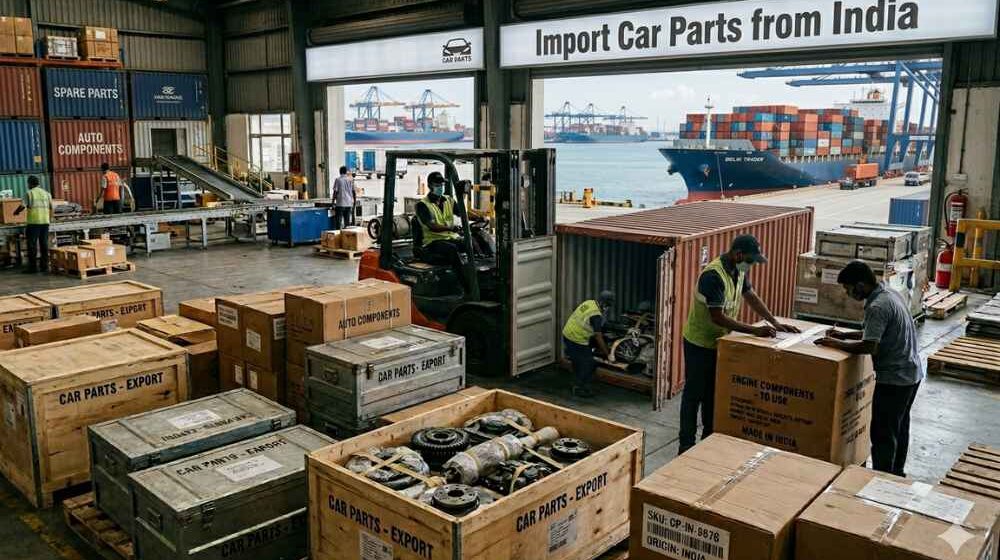
If you are running a workshop in Nigeria, managing a fleet in the UAE, or importing spare parts for a dealership in Nepal, understanding how to import car parts from India can help you access high-quality products at competitive prices. India has become a leading car parts exporter from India, supplying genuine OEM and aftermarket components to customers worldwide.
India’s auto component exports have crossed billions of dollars annually, making the country one of the most trusted sources for automotive spare parts from India. From engine components and suspension systems to body panels and electrical parts, buyers across Africa, the Middle East, Europe, and Asia rely on Indian suppliers for quality products and affordable pricing.
However, successfully importing auto parts requires more than simply finding a supplier. Understanding documentation, shipping methods, customs procedures, and supplier verification is essential for a smooth importing experience.
Why Import Car Parts from India?
India is one of the world’s largest automotive manufacturing hubs and a major center for auto components export India.
Key Benefits of Importing Auto Parts from India
- Competitive pricing compared to Europe and North America
- Access to genuine OEM spare parts
- Strong manufacturing infrastructure
- Reliable global shipping network
- English-speaking suppliers
- Availability of parts for both new and discontinued vehicle models
- International quality certifications such as ISO 9001 and IATF 16949
Because of these advantages, many businesses prefer importing auto parts from India rather than sourcing from multiple countries.
What Car Parts Can You Import from India?
India manufactures an extremely wide range of automotive components — from simple consumables to complex assemblies. Here is a breakdown of the most commonly imported categories:
Engine Parts — Pistons, gaskets, oil filters, timing belts (Brands: DENSO, Bosch India, Lumax)
Suspension & Steering — Ball joints, tie rods, shock absorbers, control arms (Brands: Gabriel India, Minda)
Braking System — Brake pads, discs, calipers, brake shoes (Brands: Brembo India, Uno Minda)
Electrical & Electronics — Alternators, starters, sensors, ECU modules (Brands: DENSO, Minda)
Body Parts — Hoods, door panels, bumpers, fenders, mirrors (OEM-grade for Maruti, Hyundai, Toyota)
Transmission — Clutch kits, gear assemblies, drive shafts (Brands: AISIN India)
Cooling System — Radiators, water pumps, thermostats, coolant hoses (Brands: Subros, Valeo India)
Filters & Fluids — Air filters, fuel filters, cabin filters (Brands: Mann Hummel India, Bosch)
Step-by-Step Process: How to Import Car Parts from India
Step 1: Identify the Exact Parts Required
Before contacting suppliers, gather complete information about the required parts.
Always confirm:
- Vehicle make and model
- Manufacturing year
- Engine type
- OEM part number
- Quantity required
The OEM part number is the most reliable method for ordering the correct component.
Step 2: Find a Reliable Indian Supplier
Selecting the right supplier is the most important step in the auto parts import process.
Look for suppliers who:
- Hold ISO 9001 or IATF 16949 certifications
- Have a valid Import Export Code (IEC)
- Supply genuine OEM spare parts
- Provide original packaging
- Have international export experience
A trusted auto parts supplier India should be able to verify part numbers using an Electronic Parts Catalog (EPC).
Warning Signs
Avoid suppliers who:
- Cannot verify OEM part numbers
- Offer unrealistically low prices
- Refuse to provide export documentation
- Have no international references
Step 3: Request a Quotation
After shortlisting suppliers, request a detailed quotation.
Your RFQ should include:
- Part numbers
- Quantities
- Shipping destination
- Preferred shipping method
- Delivery timeline
For first-time buyers, placing a sample order is highly recommended.
Step 4: Agree on Payment Terms
Common payment methods include:
T/T (Wire Transfer)
Most widely used.
Letter of Credit (LC)
Recommended for larger transactions.
PayPal or Wise
Suitable for smaller orders.
A standard arrangement is:
- 30% advance payment
- 70% before shipment
Avoid paying 100% upfront to new suppliers.
Step 5: Arrange Shipping
Once your order is ready, choose the appropriate shipping method.
Air Freight
Best for:
- Urgent shipments
- High-value parts
- Small orders
Transit Time:
3–7 Days
Sea Freight
Best for:
- Bulk shipments
- Wholesale orders
Transit Time:
15–45 Days
Many automotive spare parts exporters provide complete freight management services.
Step 6: Customs Clearance
When importing car parts from India, customs clearance is a critical step.
Required documents generally include:
- Commercial Invoice
- Packing List
- Bill of Lading or Airway Bill
- Certificate of Origin
- HS Code Classification
- Insurance Certificate
Work with a licensed customs broker to ensure compliance with local regulations.
Step 7: Inspect Goods Upon Arrival
After receiving your shipment:
- Verify quantities
- Check packaging condition
- Match OEM part numbers
- Inspect sample components
Building a long-term relationship with a trusted supplier often leads to better pricing and faster service.
Important Terms Every Importer Should Know
OEM Parts — Original Equipment Manufacturer parts. Made by or for the same manufacturer that supplies parts to the car brand’s assembly line. Highest quality standard.
Aftermarket Parts — Made by third-party manufacturers, not the original car brand. Quality varies heavily depending on the maker.
HS Code — Harmonized System Code. An 8-digit international classification number for every type of product. Used to calculate customs duties at the destination country.
IEC (Import Export Code) — A mandatory 10-digit code issued by India’s DGFT (Directorate General of Foreign Trade) to any entity that exports goods from India.
Bill of Lading (BL) — A legal document issued by the carrier confirming receipt of goods. Acts as the title document for the cargo — you need it to claim goods at the destination port.
FOB (Free on Board) — The price includes cost of goods plus loading onto the ship at the Indian port. The buyer pays for sea freight and insurance from that point onwards.
CIF (Cost, Insurance, Freight) — The price includes the cost of goods, insurance, and freight to your destination port. All-inclusive price — easier for buyers but you have less control over freight selection.
EPC (Electronic Parts Catalog) — A digital database used by suppliers to identify the correct OEM part number for a specific vehicle model, year, and variant. Eliminates wrong-part errors.
LCL / FCL — LCL is Less than Container Load (shared container). FCL is Full Container Load (you fill the whole container). LCL is cheaper for small orders; FCL is better for bulk.
IATF 16949 — An international quality management standard specifically for the automotive supply chain. A supplier holding this certification meets the highest production quality benchmarks.
Certificate of Origin — A document certifying that goods were produced in India. Required for customs and often needed to claim preferential trade duty rates under bilateral agreements.
T/T Payment — Telegraphic Transfer, which is an international wire transfer. The standard payment method between Indian exporters and international buyers.
Red Flags to Avoid
Not every supplier presenting themselves as an Indian OEM exporter is the real deal. Here are warning signs that should make you walk away:
- Cannot provide an OEM part number or original brand packaging
- Prices are 40–60% below what other verified suppliers are quoting
- No verifiable business address, GST number, or IEC code
- Only accepts 100% upfront payment via informal channels like crypto or personal PayPal
- No past customer references or verifiable export history
- Unable or unwilling to provide a pre-shipment inspection certificate
- Parts arrive without original manufacturer labels, holograms, or part numbers stamped on them
Where to Find a Trusted OEM Parts Exporter
Choosing a reliable supplier is the most important part of learning how to import car parts from India.
Assurer Auto Parts (WeAssurer) is a trusted OEM spare parts exporter and genuine auto parts supplier based in India. We supply genuine spare parts for Toyota, Hyundai, Maruti Suzuki, Honda, Nissan, Mahindra, Tata, and other leading automotive brands to customers in more than 160 countries.
Why Choose Assurer Auto Parts?
- 100% Genuine OEM Parts
- Original Brand Packaging
- Worldwide Shipping
- EPC-Based Part Number Verification
- Complete Export Documentation
- Air & Sea Freight Options
- Competitive Wholesale Pricing
- Dedicated Export Support
As a leading car parts exporter from India, Assurer Auto Parts helps workshops, distributors, dealers, and fleet operators source genuine automotive parts with confidence.
Conclusion
Understanding how to import car parts from India is essential for businesses looking to access quality products at competitive prices. By selecting a trusted supplier, verifying OEM part numbers, arranging proper shipping, and preparing accurate documentation, importers can avoid costly mistakes and build a reliable supply chain.
India remains one of the world’s most trusted sources for OEM spare parts, automotive components, and genuine replacement parts. Partnering with an experienced genuine auto parts supplier such as Assurer Auto Parts can simplify the entire process and ensure consistent quality, timely delivery, and long-term business success.