
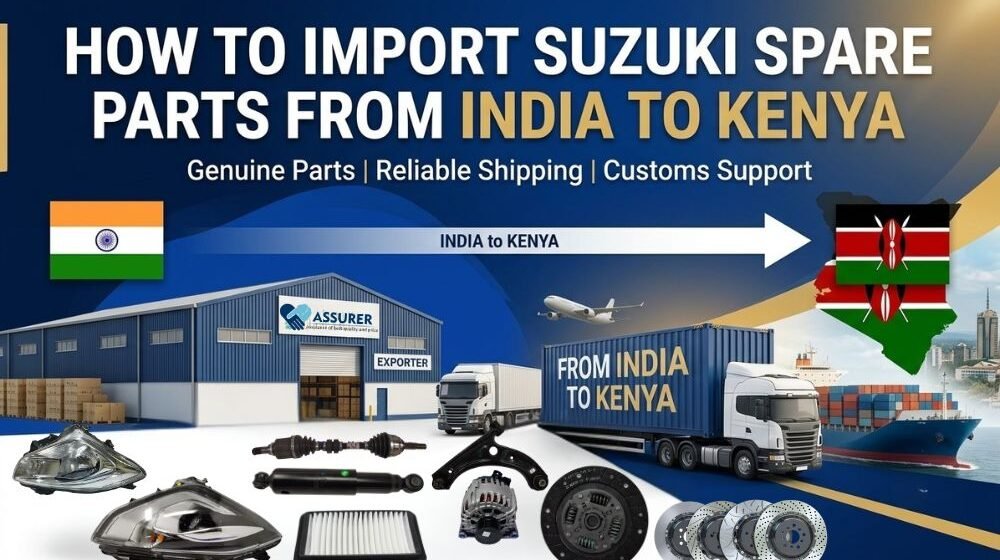
If you run a spare parts shop in Nairobi, a garage in Mombasa, or a distribution business anywhere in Kenya, you already know the problem. Suzuki vehicles are everywhere on Kenyan roads, but getting genuine parts for them at a price that leaves you a margin is not easy.
Local suppliers mark up heavily. Fake parts are sold as genuine every single day. And when a customer’s Alto or Swift comes back three weeks later with the same failed component, it is your name that suffers, not the supplier’s.
This is why more Kenyan dealers are importing directly from India.
India is where most Suzuki vehicles in the world are actually built. Maruti Suzuki has been manufacturing there for over forty years, which means India has the deepest, most mature Suzuki parts supply chain anywhere. Parts that are rare and expensive in Nairobi are ordinary stock items in Delhi.
But importing is not simply “find a supplier and pay.” Kenya has real compliance rules, and getting one of them wrong can hold your shipment at Mombasa port for weeks and add costs you never budgeted for.
This guide walks through the whole process, step by step, the way it actually works.
Why Kenyan Dealers Import Suzuki Parts from India
A few practical reasons come up again and again when we speak to buyers in Kenya.
Availability. India produces Suzuki parts at a scale no other country matches. Whether you need a front bumper for a Swift, a suspension arm for an Ertiga, or a full set of filters for a fleet of Altos, the parts exist and they are in stock.
Price. Buying at Indian export prices, even after freight and duty, usually works out lower than sourcing the same genuine part through a regional middleman. The gap is widest on body panels and slow-moving components.
Model match. Many Suzuki vehicles in Kenya arrive as used imports or are the same platforms sold in India. Alto, Swift, Dzire, Celerio, Ertiga, Vitara and Jimny all have strong Indian parts availability.
Genuine sourcing. A serious Indian exporter can supply parts with verifiable part numbers and original packaging. That matters when your reputation depends on the part lasting.
Which Suzuki Parts Kenyan Buyers Order Most
Based on what moves through export orders to East Africa, demand clusters around a few categories.
|
Category |
Commonly ordered parts |
|
Bumpers, bonnets, fenders, doors, grilles, headlights, tail lamps, mirrors |
|
|
Shock absorbers, control arms, ball joints, tie rod ends, bushes, links |
|
|
Brake pads, discs, drums, shoes, master cylinders, brake hoses |
|
|
Gaskets, belts, water pumps, timing kits, engine mounts, pistons, rings |
|
|
Alternators, starters, sensors, ignition coils, switches, wiring parts |
|
|
Oil, air, fuel and cabin filters, spark plugs, clutch kits |
Body parts and suspension components tend to be the highest-margin items for Kenyan dealers, because they are bulky, expensive locally, and hard to source in matching quality.
OEM, OES or Aftermarket: Know What You Are Buying
Before you place any order, be clear about which grade of part you want. This single decision affects your price, your warranty conversations, and your customer trust.
- OEM (Original Equipment Manufacturer) parts are made to the vehicle manufacturer’s specification and carry the manufacturer’s branding and part number. Highest cost, highest confidence.
- OES (Original Equipment Supplier) parts come from the same factory that supplies the manufacturer, but are sold under the supplier’s own brand. Practically identical quality, usually lower cost, different box.
- Aftermarket parts are made by third-party manufacturers. Quality varies enormously — from genuinely excellent to worthless.
If you are supplying workshops and fleet customers who care about reliability, stay with OEM and OES. If you are competing purely on price in a walk-in retail market, the aftermarket has a place, but be honest with your customers about what they are buying.
A trap worth naming: some exporters will quote you an aftermarket price and describe the part as “genuine.” Always ask for the part number and the brand on the box before you confirm an order.
Step-by-Step: Importing Suzuki Parts from India to Kenya
Step 1: Get Your Importer Registration in Order
Before anything ships, you need to be able to clear it.
You need a valid KRA PIN registered for import activity, and your tax compliance needs to be current. Kenya Revenue Authority checks your Tax Compliance Certificate status during clearance, and an expired one will stall your entry.
If you are importing commercially and regularly, most dealers also appoint a licensed clearing agent at this stage rather than later. A good agent is worth their fee — they know which desk to push and which classification will hold up.
Step 2: Confirm Part Numbers and Get a Proforma Invoice
This is the step most first-time importers rush, and it is the one that costs them.
Send your supplier the exact vehicle details: model, year, engine, and where possible the chassis number. Ask for the Suzuki part numbers against each line item. Then check those numbers yourself.
A proper exporter will come back with a proforma invoice listing part number, description, unit price, quantity, weight, HS code and packing details. If your supplier cannot give you HS codes, that is a warning sign — it means they have not exported to Kenya before, and you will inherit the classification problems.
Step 3: File the Import Declaration Form (IDF)
Every commercial import into Kenya requires an Import Declaration Form, filed through KRA’s iCMS system before the goods arrive. Your clearing agent normally files this using the proforma invoice details.
The IDF has to match your final shipping documents. Mismatches between the IDF, invoice and Bill of Lading are a very common cause of delays at Mombasa.
Step 4: Arrange PVoC and Get the Certificate of Conformity
This is the step that catches people out, so read it carefully.
Kenya operates the Pre-Export Verification of Conformity programme. Regulated goods must be inspected and certified in the country of export, before shipping, by a KEBS-appointed agent. The main agents operating in India are SGS, Bureau Veritas and Intertek.
The output is a Certificate of Conformity (CoC), which is submitted to KEBS and KRA through the Kenya National Electronic Single Window System. Goods arriving with a valid CoC generally get direct release, though consignments can still be targeted for surveillance testing.
If your goods arrive without a CoC, they go to destination inspection at the port — which means delay, and a penalty charged as a percentage of the customs value. It is always cheaper to do PVoC properly at the origin.
Practical advice: make PVoC the supplier’s responsibility and write it into your order. An exporter who regularly ships to Kenya will have an existing relationship with an inspection agent and will handle it as routine. One who does not will leave it to you, and you will be the one paying at Mombasa.
Since late 2025, a valid certificate of origin issued by a competent authority in the exporting country is also required on every consignment, and this is being enforced strictly. In India this is typically issued by a recognised chamber of commerce.
Step 5: Agree Payment Terms and Incoterms
Two things to settle before money moves.
Incoterms. FOB Nhava Sheva or Mundra means you take over cost and risk once the goods are loaded at the Indian port. CIF Mombasa means the supplier arranges and pays freight and insurance to Mombasa. CIF is simpler for a first order; FOB gives you more control on freight cost once you have your own forwarder.
Payment. Common structures are an advance deposit with balance against shipping documents, full advance for small orders, or a Letter of Credit for large ones. For a first order with a new supplier, keep the value modest and use a structure where the balance is only released against a Bill of Lading copy. A supplier who refuses any documented structure and insists on 100% advance for a large first order deserves more scrutiny.
Step 6: Choose Sea or Air Freight
For spare parts, the decision is mostly about weight, volume and urgency.
|
Factor |
Sea freight (LCL / FCL) |
Air freight |
|
Route |
Indian port → Mombasa |
India → JKIA Nairobi |
|
Typical transit |
Around 3–5 weeks |
A few days |
|
Best for |
Bulk orders, body panels, heavy suspension and engine parts |
Urgent restocks, small light parts, filters, sensors |
|
Cost basis |
Per cubic metre / per container |
Per kilogram |
Most Kenyan dealers building stock use sea. Air is for the emergency order when a customer’s vehicle is sitting in the workshop.
A note on LCL versus FCL: if your order fills most of a 20-foot container, FCL is usually cheaper per unit and handles better at the port. Below that, LCL consolidation is the sensible choice.
Step 7: Customs Clearance and Duty at Mombasa
Your agent lodges the entry and you settle duties and levies before release.
For imported goods into Kenya you will typically be looking at import duty under the East African Community Common External Tariff, VAT, the Import Declaration Fee, and the Railway Development Levy. The duty band depends entirely on the HS code assigned to each specific part — auto components do not all sit in one band, which is exactly why getting the classification right at proforma stage matters.
Because rates and levies are reviewed periodically, do not budget from a figure you read in a blog, including this one. Ask your clearing agent for a landed-cost estimate against your actual part list and HS codes before you confirm the order. Any competent agent will do this in a day.
Build your estimate as: CIF value, plus import duty, plus VAT calculated on the duty-inclusive value, plus IDF fee, plus RDL, plus agent and port handling, plus inland transport. When dealers get burned on margins, it is almost always because they priced off the invoice value and forgot the stack on top.
Step 8: Delivery to Your Warehouse
From Mombasa, most Nairobi-bound cargo moves by SGR rail or by road. Confirm with your agent who is arranging this and whether it sits inside their quote or outside it.
When the shipment arrives, check it against the packing list line by line before you sign off — part numbers, quantities and physical condition. Raise any shortage or damage immediately with photographs. A serious exporter will resolve a genuine discrepancy; but your claim gets much weaker once the boxes have been sitting in your store for a month.
Documents Checklist
Keep this list beside you for every shipment:
- Commercial invoice
- Packing list with weights and dimensions
- Bill of Lading (sea) or Air Waybill (air)
- Import Declaration Form (IDF)
- Certificate of Conformity (CoC) from the PVoC agent
- Certificate of origin
- Your KRA PIN and valid Tax Compliance Certificate
- Insurance certificate, where applicable
If any one of these is missing or inconsistent with the others, expect a delay.
Mistakes Kenyan Importers Make Most Often
Skipping PVoC to save time. It never saves time. It moves the inspection to Mombasa, adds a penalty, and holds your cargo.
Wrong HS classification. Guessing the code, or letting a supplier guess it, leads to reassessment at clearance and an unexpected duty bill.
Not verifying part numbers. “It fits the Swift” is not a specification. The part number is.
Trusting the word “genuine” without proof. Ask for brand, packaging and part number. Ask for photographs of the actual stock.
Budgeting only on invoice value. Duty, VAT, IDF, RDL, clearing, transport. Price your retail off landed cost, not supplier cost.
Ordering too big on the first shipment. Test a new supplier with a moderate order. Judge them on documentation quality and packing, then scale.
After the compliance, this is the decision that determines whether importing works for you.
Use this as your screening checklist:
- Registered for export. A genuine Indian exporter holds an IEC (Importer Exporter Code) and GST registration. Ask for both.
- Proven Kenya experience. Have they shipped to Mombasa before? Do they know PVoC without you explaining it?
- Part number discipline. Quotes should list part numbers, not vague descriptions.
- Honest grading. They tell you clearly whether a part is OEM, OES or aftermarket, and price accordingly.
- Export packing. Parts must be packed for a five-week sea journey, not for local delivery. Ask how body panels are protected.
- Document quality. Clean, consistent invoice, packing list and HS codes. Sloppy paperwork at origin becomes your problem at the port.
- Responsiveness. How fast do they reply before you have paid? That is the best available preview of how they behave after.
- After-sales position. What happens if a part is wrong or damaged? Get the answer in writing before the first order.
Work With Assurer
Assurer is an India-based exporter of genuine OEM automobile spare parts, supplying dealers, distributors and workshops across Africa, the Middle East and Southeast Asia.
For Kenyan buyers, that means:
- Genuine Suzuki parts sourced with verifiable part numbers
- Quotations with HS codes and clear OEM / OES grading
- Export-grade packing built for sea transit to Mombasa
- Complete export documentation support, including PVoC coordination
- Flexible order sizes — start small, scale as trust builds
Send us your part list and we will come back with a proforma invoice.
Share the Suzuki model, year and the parts you need, and our export team will respond with pricing, availability and lead time.
Frequently Asked Questions
Can I import Suzuki spare parts from India to Kenya legally?
Yes. Importing automotive spare parts from India into Kenya is entirely legal, provided you meet Kenya’s import requirements — importer registration with KRA, an Import Declaration Form, PVoC certification with a Certificate of Conformity, a certificate of origin, and payment of applicable duties and levies.
What is PVoC and do I need it for spare parts?
PVoC is Kenya’s Pre-Export Verification of Conformity programme. Regulated goods must be inspected and certified before shipment by a KEBS-appointed agent in the exporting country, such as SGS, Bureau Veritas or Intertek in India. Without a Certificate of Conformity, your shipment faces destination inspection at the port plus a penalty based on customs value.
How long does shipping take from India to Kenya?
Sea freight from Indian ports to Mombasa typically takes around three to five weeks depending on the route, sailing schedule and whether you ship LCL or FCL. Air freight to Nairobi takes a few days but costs considerably more per kilogram.
What documents do I need to clear spare parts at Mombasa?
You need a commercial invoice, packing list, Bill of Lading or Air Waybill, Import Declaration Form, Certificate of Conformity from the PVoC agent, and a certificate of origin. Your KRA PIN and valid Tax Compliance Certificate must also be in order.
How much duty will I pay on imported Suzuki parts?
It depends on the HS code of each specific part under the EAC Common External Tariff, plus VAT, the Import Declaration Fee and the Railway Development Levy. Because auto components fall into different duty bands, ask your clearing agent for a landed-cost estimate against your actual part list before confirming an order.
Is there a minimum order quantity for importing?
This varies by supplier. Many Indian exporters accept consolidated mixed orders rather than enforcing a high minimum per part, which lets you build a varied stock list in one shipment. Confirm the policy before you plan your order.
How do I know the parts are genuine and not fake?
Ask for the Suzuki part number for every line item, request photographs of the actual stock and packaging, and confirm in writing whether each part is OEM, OES or aftermarket. Suppliers who avoid these questions should be avoided.
Should I buy OEM or aftermarket Suzuki parts for the Kenyan market?
If you supply workshops, fleets or customers who value reliability, OEM and OES parts protect your reputation and reduce returns. Aftermarket can work for price-sensitive retail, but you should tell customers clearly what they are buying.
Can the supplier handle PVoC and export documentation for me?
An experienced exporter that regularly ships to Kenya will coordinate PVoC inspection and prepare complete export documentation as part of normal service. Make this an explicit condition of your order rather than assuming it.
What is the safest way to pay a new Indian supplier?
Keep your first order modest and use a structure where a deposit is paid upfront and the balance is released against shipping documents. For high-value orders, a Letter of Credit offers the strongest protection for both sides.