
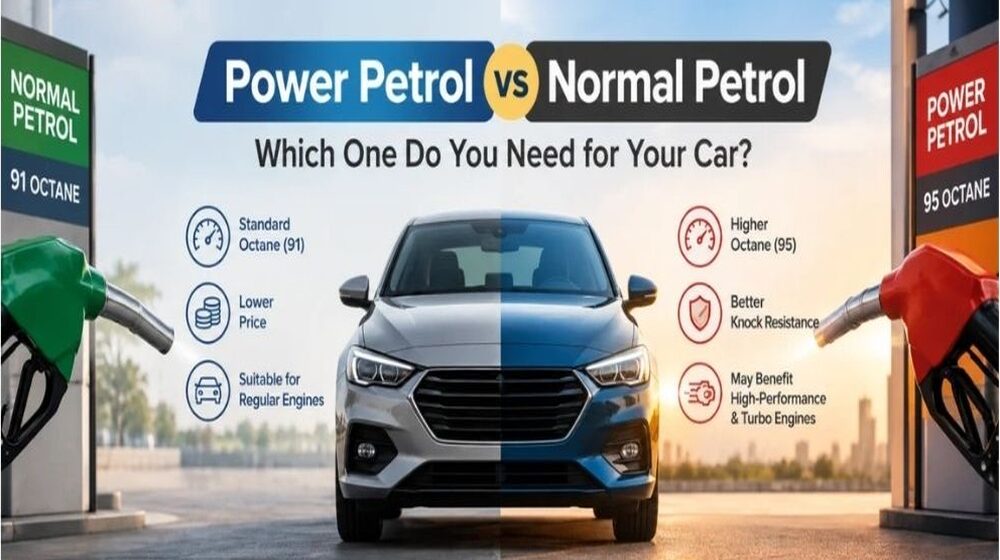
A typical question many owners of turbo vehicles often ask is that :- Should I use the standard petrol or the power petrol for my turbo engine? its mainly Power Petrol vs Normal Petrol.Turbocharged petrol engines have grown in popularity because they offer great power and better performance from smaller engines.
Choosing your Fuel is critical for engine performance, smoothness and long term reliability. Power petrol is often a higher-octane grade of fuel that resists knocking and helps engines operating under higher-pressure circumstances. Here the quality of the fuel matters. Turbocharged engines have higher cylinder pressures because the turbocharger forces more air into the combustion chamber.
But does every turbo car demand power petrol? Is normal petrol bad for turbo engines? It is contingent upon your car manufacturer recommendation, engine calibration and operating circumstances.
Let’s learn deep about the concept of power petrol vs normal petrol and know which one is best for turbo vehicle owners.
What is Normal Petrol?
The usual petrol is the standard fuel offered at most fuel stations. It has a lower octane rating than premium or power petrol and is intended for conventional engines that run at normal compression levels.
Most naturally aspirated petrol engines are built to run effectively on regular petrol. Normal fuel is often fine for daily commutes, city driving and for cars that don’t need extreme performance.
Advantages of Normal Petrol
- Lower fuel cost than petrol power
- Available at practically every fuel station
- Fits most conventional petrol engines
- Good choice for everyday driving
- Helps keep running costs down for budget-minded users
Disadvantages of Normal Petrol
- Reduced resistance to engine knock
- May not be able to give maximum performance in high-performance engines
- Performance degradation may occur with the turbo engines if the manufacturer recommends a higher octane fuel
- Not as well suited to demanding driving situations
What is Power Petrol
Power petrol is a premium fuel that has a higher octane rating and more additives. Higher octane fuel can take more compression before it ignites . This helps to eliminate undesirable knocking / pinging in the engine .
Combustion in turbocharged engines is at higher pressure and temperature . That means some turbo engines do benefit from higher octane fuel, especially if they are worked hard or the manufacturer recommends it.
Advantages of Power Petrol
- Improved resilience to knocking
- More efficient engine running
- Better throttle responsiveness with compatible engines
- Helps to increase turbo engine performance
- Helps keep combustion cleaner with quality additives
- Better choice for performance orientated driving
Disadvantages of Power Petrol:
- More expensive per litre.
- Benefits may be restricted on engines intended for regular petrol
- Not always necessary for casual city driving
- This has a higher availability than ordinary petrol
What Is Octane Number in Petrol?
The Octane Number indicates how resistant petrol is to knocking or premature combustion inside an engine. A higher octane rating means the fuel can withstand greater pressure before it starts knocking.
In India, regular petrol is generally rated at 91 octane, while premium petrol options such as XP95 and Power95 have a 95-octane rating. Higher-octane petrol is particularly useful for engines that are designed or tuned to operate with higher-octane fuel.
For Example Imagine two petrol cars:
- Car A: Its engine is designed to run on 91-octane petrol. Regular petrol is suitable because it meets the engine’s minimum octane requirement.
- Car B: Its engine is designed to work with 95-octane petrol. Using 95-octane fuel provides greater resistance to knocking under the higher pressures the engine may produce.
In simple terms, 91 and 95 are not grades that directly tell you how powerful the petrol is. They indicate how well the fuel can resist knocking.
Power petrol vs Normal petrol:- Quick Review
|
Comparison Factor |
Normal Petrol |
Power Petrol |
|
Octane Rating |
Standard octane level suitable for regular engines |
Higher octane rating with better resistance to knocking |
|
Turbo Engine Compatibility |
Works if the manufacturer allows regular petrol |
Better suited for many turbocharged and performance engines |
|
Engine Performance |
Provides normal power delivery for daily driving |
Can improve throttle response and engine smoothness in compatible engines |
|
Knocking Protection |
Lower protection under high pressure conditions |
Better protection against knocking due to higher fuel stability |
|
Acceleration Response |
Normal pickup and acceleration |
Quicker response, especially during hard acceleration |
|
Fuel Efficiency |
Good mileage for regular engines |
May provide better efficiency in engines designed for premium fuel |
|
Engine Smoothness |
Standard engine operation |
Cleaner combustion and smoother performance |
|
Engine Protection |
Basic protection for normal driving |
Better protection under high temperature and pressure conditions |
|
Cost Effectiveness |
More affordable and economical for daily use |
Higher price per litre |
|
Availability |
Available at almost every fuel station |
Available only at selected fuel stations |
|
Best Driving Condition |
City driving, normal commuting, relaxed driving |
Highway driving, spirited driving, performance usage |
|
Best Choice For |
Naturally aspirated engines and regular petrol cars |
Turbo engines, high-performance cars, premium vehicles |
Myth vs Reality

Myth:- Power petrol always gives more power.
Reality:- Higher octane does not automatically create more power. It mainly provides greater resistance to knocking and can benefit engines designed for higher-octane fuel.
Myth:- Higher octane always means better mileage
Reality:-Not automatically. Fuel economy depends on the engine, driving style, traffic, road conditions and fuel specification.
Myth:- 91-octane petrol is low-quality petrol.
Reality:- 91 octane is a standard petrol grade. Octane number mainly indicates resistance to knocking, not simply overall fuel quality.
Myth:- Higher octane means the fuel contains more energy.
Reality:- Octane rating primarily describes knock resistance; it does not simply mean that the fuel contains proportionally more energy.
Myth:- Power petrol is necessary for normal city driving.
Final Verdict: Power Petrol vs Normal Petrol?
In the context of power petrol vs normal petrol, Most of the time, conventional fuel is a sensible, cheap choice for everyday cars. Turbocharged cars, however, are more sensitive to fuel quality, since they run at higher pressures and temperatures.
Ultimately, the final choice of power petrol versus regular petrol will rely on the requirements of your vehicle and the manner in which you drive. If you have a turbo vehicle and drive in an adventurous way or regularly use highways, then power petrol could be what you need.
“The smartest decision is not necessarily the most expensive fuel – it is the fuel that fits your engine needs.”
At Assurer, we provide genuine automotive spare parts and components, ranging from engine components to fuel system components to ignition components and filters, among other automotive products that can be used in new petrol cars and ethanol compatible automobiles.
What happens if we mix power petrol with normal petrol?
Mixing power petrol with normal petrol is generally safe for your vehicle, as both fuels are compatible with most petrol engines, but the performance benefits of power petrol may be reduced.
Will power petrol increase mileage?
Power petrol may improve mileage slightly in some engines, but the difference is usually minimal and depends on the vehicle’s engine and manufacturer’s recommendations.
Is power petrol and E20 the same?
No, power petrol and E20 petrol are different: power petrol contains additives to improve engine performance, while E20 petrol is a fuel blend containing up to 20% ethanol and 80% petrol.
Is Power 95 and XP95 the same?
Is power petrol good or normal petrol?
Normal petrol is suitable for most vehicles, while power petrol may offer better performance in some engines, depending on the manufacturer’s recommendations.