
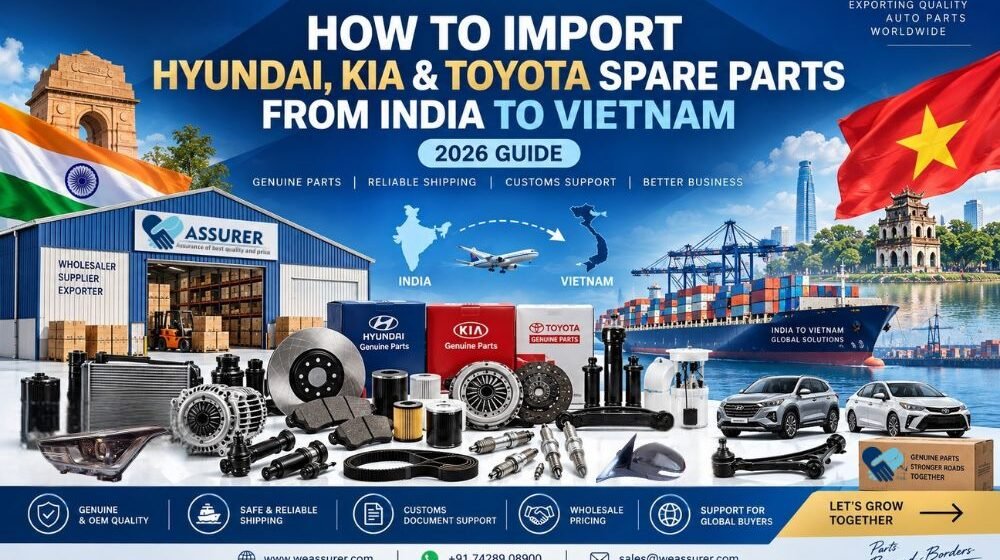
Most Vietnamese buyers who get in touch with us start with the same question.
“Why should I buy from India?”
It’s a fair question. For years, parts importers in Vietnam have bought mostly from China, Thailand or Korea. India wasn’t really on the list. That’s changing, and if you sell Hyundai, Kia or Toyota parts, it’s worth understanding why.
This guide covers what we tell every new buyer: why India makes sense, what paperwork you’ll need, and what a first order looks like from start to finish. We’ve written it the way we’d explain it over a phone call.
So, why India?
The simple answer is that a lot of these parts are made here.
Hyundai’s biggest factory outside Korea is in India. Kia builds cars here too, and Toyota has been manufacturing in India for over 25 years. Hundreds of parts makers have grown up around these plants, and many of them supply the car companies directly.
When you buy from India, you’re buying close to the source instead of from a trader three steps away.
Then there’s the price. Manufacturing costs in India are lower than in many other countries. On fast-moving items like filters, brake pads and clutch kits, you really feel that difference once you add up a full container.
Shipping isn’t a headache either. Ho Chi Minh City and Hai Phong are a short sea trip from Indian ports, so you’re not waiting months for your stock.
There’s one more thing many buyers don’t know. India and Vietnam are both part of the ASEAN-India trade agreement. If your shipment comes with the right certificate of origin, called Form AI, many products get a lower import duty. The exact rate depends on the HS code, so check it with your customs broker. For a lot of buyers, this alone changes the numbers.
About the word "genuine"
Every supplier uses it. You’ve probably heard it so often that it doesn’t mean much anymore.
Here’s what it means with us. If we call a part genuine, it has the correct part number matched to the maker’s catalogue, and we have the purchase record to show where it came from. If a part is OEM-quality instead, we say so on the quote, clearly.
Some buyers want only genuine parts for dealers and premium garages. Others want good OEM-quality parts at a better price for their local market. Both are fine. What’s not fine is paying for one and receiving the other.
We don’t mix them up. Ever.
Paperwork: where most first orders go wrong
To be honest, the parts are the easy bit. The documents are where shipments get stuck.
For a shipment from India to Vietnam, you’ll need:
- Commercial invoice, listing every item with its quantity and price. It has to match what’s inside the boxes.
- Packing list, showing which carton holds what, with weights and sizes.
- Bill of lading for sea freight, or an airway bill for air.
- Certificate of origin (Form AI), the document that gets you the lower duty.
- Correct HS codes for each item. A wrong code is one of the most common reasons for delays.
Some items may need extra checks on the Vietnamese side, and your broker will know if anything on your list falls into that group.
Also, Vietnam doesn’t allow used car parts to be imported. Everything we ship is brand new, so that’s never a problem.
We do all our export paperwork ourselves. Before a carton is sealed, we record what’s inside, how much it weighs and how big it is. It’s slow work, but it’s why our invoices and packing lists match the goods. When the paper matches the box, customs has very little to question.
What can you order?
Mostly the parts that sell every week, for the Hyundai, Kia and Toyota models you see on Vietnamese roads.
That means filters, belts, gaskets, water pumps and spark plugs. Brake pads, shoes and discs. Shock absorbers, link rods, tie rod ends and control arms. Clutch plates and bearings. Sensors, coils and switches. Lamps, mirrors and bumpers.
If you need something that isn’t mentioned here, send us the part number anyway. If it’s available in India, there’s a good chance we can get it for you.
How ordering works
It’s a short process.
- You send us your list on WhatsApp or email, with part numbers, models and quantities. An Excel sheet is ideal, but a clear photo of your list works too.
- We check stock and send you a quote with prices, genuine or OEM-quality options, and a dispatch date.
- You confirm, we agree on payment terms, and we start picking and packing your order.
- Every part is checked and packed in export cartons, and the invoice, packing list and certificate of origin are prepared to match.
- Then it ships. You get the documents before the goods arrive, so your broker can prepare for clearance early.
Who we sell to
We only sell to businesses. For Vietnam, we don’t handle single pieces or retail orders. Our buyers are importers, distributors, wholesalers, dealers and workshops who order regularly and in volume. If that sounds like you, we should talk.
A little about us
We’re Assurer, an auto parts exporter, wholesaler and retailer in India. We run a 10,000 sq ft warehouse and two shops, each with its own storage. Keeping stock under our own roof means we can check every part properly and pack export orders without rushing.
We don’t claim to be the biggest supplier out there. We just try to be the one that sends the right part with the right papers, every time.
Send us your list
The easiest way to start is to send your part list and let us quote it. There’s no commitment.
WhatsApp: +91 74289 08900
Website: www.weassurer.com
Can I import Hyundai, Kia and Toyota spare parts from India to Vietnam?
Yes, Vietnamese businesses can import Hyundai, Kia and Toyota spare parts from India, subject to Vietnam’s applicable customs and import regulations. The exact requirements can vary depending on the type of part, HS code, country of origin and shipment details. Buyers should check the current import requirements with their Vietnamese customs broker before placing an order.
What is the import duty on Hyundai spare parts from India to Vietnam?
There is no single import duty rate for all Hyundai spare parts. The applicable rate depends on the HS code, product type, origin and applicable trade agreement. Some automotive parts may qualify for preferential treatment under AIFTA, while others may not. It is best to confirm the exact HS code and applicable tariff before finalizing your order.
Can I get preferential duty under AIFTA?
Some eligible products imported from India to Vietnam may receive preferential tariff treatment under the ASEAN-India Free Trade in Goods Agreement (AIFTA). However, eligibility depends on the product’s HS code, origin requirements and other conditions. Your supplier and customs broker can help verify whether your particular spare parts qualify.
What is Form AI?
Form AI is a Certificate of Origin used under the ASEAN-India trade agreement. It can be used to support a claim for preferential tariff treatment when eligible goods are exported from India to Vietnam. The product must meet the applicable rules of origin and other AIFTA requirements, so Form AI does not automatically mean that every spare part will receive a lower duty rate.
How do I find the correct HS code for auto spare parts?
The correct HS code depends on the actual type and characteristics of the spare part, rather than simply the vehicle brand. Brake components, filters, electrical parts, body parts and other components can have different classifications. Before importing, provide your supplier and customs broker with the exact part description and specifications so the correct HS code can be confirmed.
What Hyundai spare parts can I import from India?
Depending on availability, you can source a wide range of Hyundai replacement parts from India, including oil and air filters, brake pads, clutch components, belts, bearings, suspension parts, sensors, electrical components, lamps, mirrors and body parts. Availability depends on the specific Hyundai model, variant, part number and required quantity.
Can I order Kia spare parts by part number?
Yes. Ordering by Kia part number is one of the easiest ways to identify the exact component you need. When requesting a quotation, provide the part number along with the vehicle model, variant, manufacturing year and required quantity whenever possible. This helps the supplier check compatibility and availability more accurately.
Can I import Toyota genuine spare parts from India?
Yes, genuine Toyota spare parts can be sourced from India when they are available through legitimate supply channels and meet the applicable export and import requirements. If you specifically require genuine parts, confirm the part number, packaging, source and product classification with the supplier before placing your order.
What documents are required to import auto parts into Vietnam?
The required documents can vary according to the shipment and product. Common export and import documentation may include a commercial invoice, packing list, bill of lading or airway bill, certificate of origin and customs documentation. Additional documents or checks may apply to certain products, so Vietnamese importers should confirm the requirements with their customs broker before shipment.
How can I find a reliable auto spare parts supplier in India?
Look for a supplier that can provide accurate part numbers, clear product information, genuine or OEM-quality options, transparent quotations, proper export documentation and experience with international shipments. Before placing a large order, send your complete part list and ask for product details, pricing, availability and shipping terms. This makes it easier to compare suppliers and avoid ordering the wrong parts.