
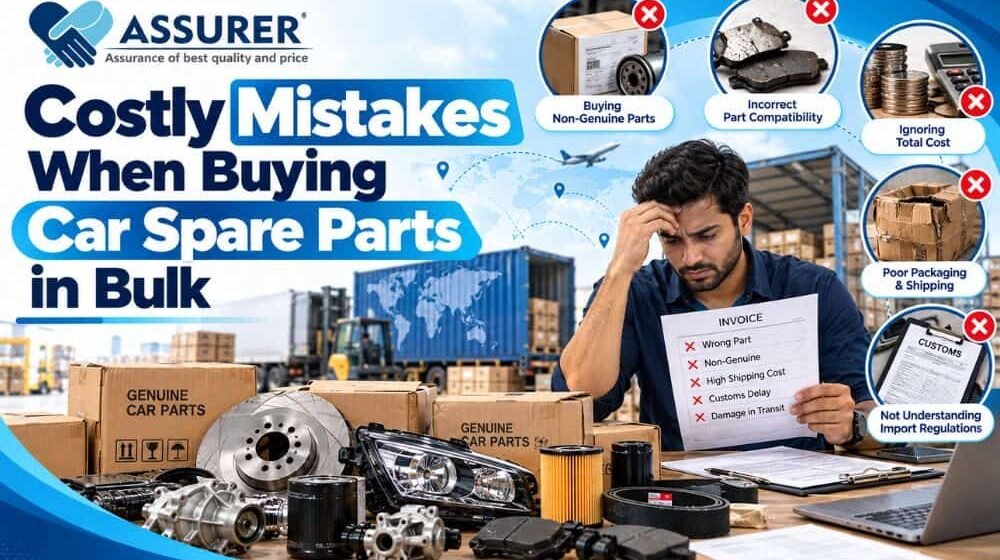
Buying car spare parts in bulk sounds simple. Find a supplier, agree a price, place the order, and wait for the boxes to arrive.
But anyone who has done it for a while knows the truth. One wrong decision in a bulk order doesn’t cost you one part. It costs you hundreds. Wrong parts sit on your shelves for months. Fake parts come back from angry customers. And surprise shipping costs can wipe out your entire profit.
Whether you run a workshop in India, a parts shop in Africa or an import business in the Middle East or Southeast Asia, these mistakes look the same everywhere. Here are the five most expensive ones, and exactly how to avoid them.
Why Bulk Buying Mistakes Hurt So Much
When you buy one part for one car, a mistake is annoying. You return it, swap it and move on.
In bulk, everything multiplies:
- One wrong part number becomes 100 wrong parts.
- One bad supplier affects every customer who buys from you.
- One missing document can hold your whole shipment at customs.
And your money stays stuck until the problem is fixed. That’s why a little checking before you order saves much more than any discount.
Mistake 1: Choosing a Supplier Only Because They're the Cheapest
What it looks like
You get five quotes and pick the lowest one. It feels like smart business. But a price far below everyone else’s usually means something is missing. It could be copy parts in look-alike boxes, old stock, poor packing, or costs that show up later.
What it really costs you
Imagine you buy 200 brake pads at a very low price. Within a few weeks, customers come back with noisy brakes and fast wear. Now you’re handling returns, losing customers, and your shop’s name takes the hit. Your “saving” is gone, and then some.
How to avoid it
- Compare suppliers on value, not just price genuine quality, packing, paperwork and support.
- If one quote is far lower than the rest, ask why before you get excited.
- Ask exactly what’s included packing, documents, delivery to port, insurance.
- Start with a smaller first order to test quality before going big.
In short: The cheapest quote often ends up being the most expensive order.
Mistake 2: Not Checking Part Numbers and Fitment
What it looks like
You order by model name, like “Scorpio clutch plate” or “Creta headlight.” But one model can have many versions. Different engines, years, variants, and even left-hand or right-hand drive versions often use different parts.
What it really costs you
The parts arrive, look right, but don’t fit the cars your customers drive. Now you have dead stock parts you paid for that nobody can use. In bulk orders, this can lock up a big part of your cash for months.
How to avoid it
- Always order by OEM part number, not just by model name.
- Share the VIN, engine type and model year with your supplier when unsure.
- Check if your market uses LHD or RHD vehicles, since parts like steering racks, wipers and dashboards differ.
- Ask the supplier to confirm fitment in writing before you pay.
In short: A part that “almost fits” is a part that doesn’t sell.
Mistake 3: Not Checking If the Supplier and Parts Are Genuine
What it looks like
You find a supplier online, the photos look good, the price is fine, and you place a big order straight away. You never check if the business is real, and you never see a sample.
What it really costs you
Fake parts are a big problem in the spare parts market. Some come in packaging that looks almost identical to the original. If you sell them, your customers’ cars are at risk, and so is your reputation. In some cases, you may never even get the goods.
How to avoid it
- Check the business: company registration, tax details, export licence (for exporters), physical address and how long they’ve been trading.
- Ask for references: or reviews from other buyers, especially in your region.
- Order samples first: Compare them with a genuine part you trust.
- Check the packaging closely: brand labels, part numbers, holograms or QR codes (where the brand uses them), and print quality.
- Talk to them: A real supplier answers technical questions clearly and quickly.
In short: If you can’t verify it, don’t buy it in bulk.
Mistake 4: Buying the Wrong Mix of Stock
What it looks like
You see a good bulk deal and fill your order with whatever is cheapest per piece. Or you order big quantities of parts that sell once in a while, and too few of the parts your customers ask for every day.
What it really costs you
Slow-moving parts eat your cash and shelf space. Meanwhile, you run out of fast-moving parts and lose sales to the shop next door. Over time, you end up with a warehouse full of stock and not enough money to buy what actually sells.
How to avoid it
- Look at your sales history: Which parts do customers ask for every week?
- Focus on fast-moving parts: filters, brake pads, clutch parts, bulbs, belts, suspension parts and others that wear out regularly.
- Know the popular cars in your area: Stock for the vehicles people actually drive there.
- Order slow-moving parts in small quantities: or on demand.
- Ask your supplier: what other buyers in your region usually order. Good suppliers will share this.
In short: Buying lots of parts is easy. Buying the right parts is the skill.
Mistake 5: Ignoring Shipping, Packing and Paperwork
What it looks like
You agree on a good price per part and stop there. You don’t ask about freight, insurance, import duty, how fragile items will be packed, or what documents come with the shipment.
What it really costs you
Your real cost is the landed cost parts + freight + insurance + duty + clearing charges + local transport. If you don’t plan for it, your profit can disappear. Poor packing means broken headlamps and cracked glass after a long sea journey. And missing or wrong documents can keep your goods stuck at the port, with storage charges adding up every day.
How to avoid it
- Agree Incoterms clearly.
- FOB: the supplier delivers to the port in their country, and you arrange shipping from there.
- CIF: the supplier pays for shipping and insurance to your port.
- Calculate the landed cost: before you confirm the order.
- Ask how fragile parts are packed: lamps, glass, sensors and electronics need extra protection.
- Check the documents: you’ll receive. Usually this means a commercial invoice, packing list, bill of lading (sea) or airway bill (air), and certificate of origin.
- Choose the right shipping mode: air for small, urgent orders; sea for large orders, which costs much less per part.
In short: The price of the parts is not the price you pay.
Bonus Mistake: No Written Return or Warranty Terms
Many buyers only ask about returns after something goes wrong. By then, it’s too late to argue.
Before paying, agree in writing:
- What happens if wrong parts are sent?
- What happens if parts arrive damaged?
- How defective parts are handled?
- Who pays for return shipping?
Also agree to payment terms clearly. Many experienced importers prefer paying in stages by bank transfer (TT) or using a Letter of Credit (LC) for larger orders. Be careful with any supplier who wants full payment upfront with no proper paperwork
Quick Summary Table
|
Mistake |
Hidden Cost |
How to Avoid It |
|
Choosing only the cheapest supplier |
Fake parts, returns, lost customers |
Compare value, not just price; test with a smaller order |
|
Not checking part numbers |
Dead stock that doesn’t fit |
Order by OEM part number; confirm fitment in writing |
|
Not verifying supplier and parts |
Counterfeits, lost money |
Check business details, references and samples |
|
Wrong stock mix |
Cash stuck in slow-moving parts |
Use sales history; focus on fast movers |
|
Ignoring shipping and paperwork |
Damage, customs delays, lost profit |
Agree Incoterms, check packing and documents, calculate landed cost |
Genuine vs Aftermarket vs Fake: Know the Difference
|
Type |
What It Is |
Is It Safe to Buy? |
|
Genuine / OEM |
Made by or for the car maker, sold under its brand |
Yes, best fit and quality |
|
Quality aftermarket |
Made by a known brand to fit your car, sold under its own name |
Yes, when the brand is trusted |
|
Fake / counterfeit |
Copy part made to look like the genuine one |
No, risky for safety and your reputation |
There’s nothing wrong with good aftermarket parts, as long as they’re sold honestly as aftermarket. The problem starts when copies are sold as genuine.
Your Bulk Order Checklist
Save this and use it before every big order:
- I’ve checked the supplier’s business details and references
- I’ve seen or tested samples
- Every item is ordered by OEM part number
- Fitment (model, year, engine, LHD/RHD) is confirmed in writing
- My order focuses on parts that sell fast in my market
- I’ve agreed Incoterms (FOB or CIF)
- I’ve calculated the full landed cost
- I know how fragile parts will be packed
- I know which documents I’ll receive
- Payment, return and warranty terms are agreed in writing
How Assurer Helps Bulk Buyers
We see these mistakes all the time, and we’ve built the way we work to help buyers avoid them.
Assurer is a New Delhi–based supplier and exporter of genuine Hyundai parts, Maruti Suzuki Parts, Mahindra Parts and other leading brands. We supply workshops, retailers, distributors and importers in India and around the world.
Here's how we make bulk buying safer:
- Genuine parts, quoted by part number, so you know exactly what you’re getting
- Fitment help before you order, so wrong parts don’t end up as dead stock
- Careful export packing, with weights and sizes recorded for every carton
- Complete export documents, with every shipment, commercial invoice, packing list, bill of lading and certificate of origin
- Trusted shipping partners DHL for urgent air orders, and Maersk, MSC and CMA CGM for sea freight
- Quick quotations on WhatsApp and email, usually within 24 hours
Planning your next bulk order? Send your part list on WhatsApp at +91 74289 08900 or through our contact page, and our team will check every part and get back to you with a clear quotation.
Final Thoughts
Bulk buying is one of the best ways to grow a spare parts business, but only when it’s done carefully. Most expensive mistakes come from rushing, picking the lowest price, skipping checks, or forgetting about shipping and paperwork.
Take a little extra time before each order. Check the supplier, confirm every part number, buy what really sells, and know your full landed cost. Your profits, and your customers, will thank you.
FAQs
Is buying car spare parts in bulk cheaper?
Usually, yes. Bulk orders get better prices per part. But you only save money if you buy the right parts from a reliable supplier and plan for shipping and duty.
How do I find a reliable bulk car parts supplier?
Check their business details, ask for references, order samples first, and see how clearly they answer your questions. A good supplier quotes by part number and shares full paperwork.
How can I check if spare parts are genuine?
Compare them with a part you know is genuine. Check the brand labels, part number, print quality and any holograms or QR codes. Buying from a trusted supplier is the safest way.
Should I order samples before a bulk order?
Yes, especially with a new supplier. A sample order lets you check quality, packing and communication before you commit a large amount of money.
What documents do I need to import car spare parts?
Usually a commercial invoice, packing list, bill of lading or airway bill, and certificate of origin. Your country may need more, so check with your customs agent.
Which is better, FOB or CIF?
FOB gives you more control if you have your own freight forwarder. CIF is easier if you want the supplier to handle shipping to your port. Compare the total landed cost both ways.
Which spare parts should I buy in bulk?
Fast-moving parts that wear out regularly, like filters, brake pads, clutch parts, belts, bulbs and suspension parts, for the cars that are most popular in your area.
Are aftermarket parts bad?
Not at all. Good aftermarket parts from trusted brands work well and cost less. The real problem is fake parts sold as genuine.