

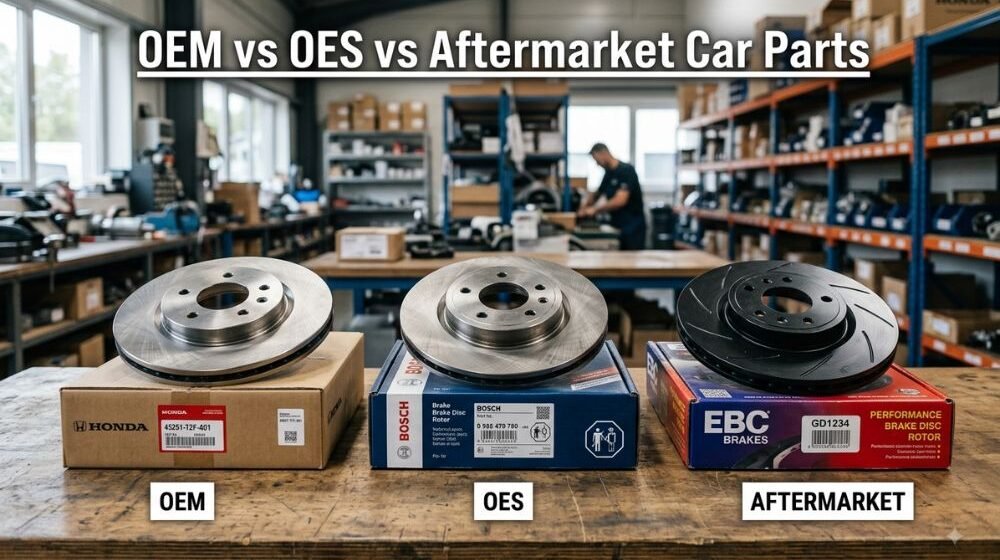
If you’ve ever ordered a spare part for your car, chances are you’ve come across these three terms — OEM, OES, and aftermarket. Most buyers, whether individual car owners or bulk importers, end up confused between the three. Sometimes a seller calls a part “genuine,” sometimes “original,” and sometimes “OEM-grade” — but each term actually means something different, and that difference directly affects your car’s performance, safety, and warranty.
In this guide, we’ll break down these three categories in simple, practical terms — no technical jargon — so that the next time you or your supplier orders a part, you can make the right call.
What Are OEM Parts?
OEM stands for Original Equipment Manufacturer. In simple terms, these are parts made directly by the same company that manufactured your car — brands like Maruti Suzuki, Hyundai, Toyota, or Honda.
These parts come in the car manufacturer’s own branded packaging, built to the exact specifications used in the original vehicle. Since their manufacturing process and quality control fall directly under the car maker’s standards, fitment and performance are virtually guaranteed.
Key points:
- Carry the car manufacturer’s brand name
- Match exact original specifications
- Priced higher due to assured quality
- Best choice for warranty-critical repairs
What Are OES Parts?
OES stands for Original Equipment Supplier. This one tends to confuse people since it sounds similar to OEM, but the difference is actually straightforward.
Many car companies don’t manufacture every part in-house — they source them from third-party suppliers (like Bosch, Denso, or Delphi) and then sell them under their own brand. OES parts are the exact same components, but sold without the car company’s label — instead, they come packaged under the original supplier’s own brand.
In terms of quality, OES and OEM are nearly identical since both come off the same production line — the only real difference is branding and packaging.
Key points:
- Same manufacturing quality as OEM
- Comes in the original supplier’s branding (not the car company’s)
- Usually priced slightly lower than OEM
- No compromise on fitment or performance
What Are Aftermarket Parts?
Aftermarket parts are made by companies that have no direct connection to the original car manufacturer. These are independent, third-party manufacturers producing generic or compatible parts designed to fit multiple car models.
This is where you’ll see the widest quality variation. Some aftermarket brands genuinely deliver good quality, close to OEM performance, while others cut corners on materials and processes just to keep costs low.
Key points:
- Most affordable option
- Quality varies significantly by brand — research is essential
- Wider variety, especially for older or discontinued models
- Warranty coverage is limited or, in many cases, non-existent
OEM vs OES vs Aftermarket — Comparison Table
| Factor | OEM | OES | Aftermarket |
|---|---|---|---|
| Manufacturer | Car company itself or authorized unit | Original third-party supplier (to the car company) | Independent third-party companies |
| Branding | Car maker's logo/brand | Supplier's own brand | Aftermarket brand name |
| Quality Consistency | Highest, standardized | Highest, same as OEM | Variable — depends on brand |
| Price | Highest | Slightly lower than OEM | Lowest |
| Fitment Accuracy | Perfect, exact match | Perfect, exact match | Good to average, depends on model |
| Warranty | Full manufacturer warranty | Supplier warranty | Limited or seller-dependent |
| Availability | Authorized dealers/exporters | Specialized distributors | Widely available, including local markets |
Which Option Is Right for You?
This decision depends on which category you fall into:
- For B2B buyers and exporters — If you’re importing parts in bulk for resale or workshop use, OEM or OES parts are the safest bet, since consistency and trust are essential for customer retention. A single defective batch can damage your business reputation.
- For daily use and routine maintenance — If the part isn’t critical (like floor mats or minor trims), aftermarket can be a reasonable, budget-friendly choice — just stick to a trusted brand.
- For warranty-critical repairs — If your car is still under manufacturer warranty, always go with OEM parts, or you risk voiding that warranty.
- For safety-critical parts (brakes, suspension, steering components) — OEM or high-grade OES is strongly recommended, since quality here is directly tied to safety.
Which Option Is Right for You?
This decision depends on which category you fall into:
- For B2B buyers and exporters — If you’re importing parts in bulk for resale or workshop use, OEM or OES parts are the safest bet, since consistency and trust are essential for customer retention. A single defective batch can damage your business reputation.
- For daily use and routine maintenance — If the part isn’t critical (like floor mats or minor trims), aftermarket can be a reasonable, budget-friendly choice — just stick to a trusted brand.
- For warranty-critical repairs — If your car is still under manufacturer warranty, always go with OEM parts, or you risk voiding that warranty.
- For safety-critical parts (brakes, suspension, steering components) — OEM or high-grade OES is strongly recommended, since quality here is directly tied to safety.
Why Choose Genuine OEM Parts from Assurer
Assurer exports genuine OEM automobile spare parts from India to markets across the Middle East, Africa, and Southeast Asia — without compromising on quality or authenticity. Every part is verified against manufacturer specifications, so you never have to worry about fitment issues or duplicate parts.
Whether you need genuine Maruti Suzuki Parts, Hyundai Parts, Toyota Parts, or Honda Parts, Assurer is a reliable sourcing partner for both bulk exporters and workshops.
FAQs
Are OES parts genuine, just like OEM?
Yes, OES parts are the same factory-quality components as OEM — the only difference is branding, since they’re sold under the original supplier’s name instead of the car company’s name.
Are aftermarket parts always low quality?
No, not all aftermarket parts are low quality. Some established aftermarket brands offer good quality, but consistency isn’t guaranteed the way it is with OEM/OES — so always buy from a trusted seller.
Why are OEM parts so expensive?
OEM parts cost more because their manufacturing falls directly under the car company’s strict quality control, plus you get the added assurance of brand warranty and guaranteed fitment.
Does using an aftermarket part void my car's warranty?
In some cases, yes — especially if the part failure is directly related to the warranty claim. It’s always safer to use OEM parts during the warranty period.
For bulk import business, is OEM or OES better?
Both are reliable in terms of quality. OES can be more cost-effective without compromising on quality, making it a good option for margin-conscious bulk buyers.