

Buying a car in India is never just about looks or brand. For most Indian families and professionals, running costs are everything. And the single biggest running-cost decision you’ll make is: petrol or diesel? Understanding the petrol vs diesel car comparison is important because it directly affects your fuel expenses, maintenance costs, and long-term ownership experience. Many buyers today also want to know petrol vs diesel car which is better for their daily driving needs and future savings.
This debate has been going on for decades — but 2026 has changed the equation. Petrol engines are more efficient than ever, while diesel cars face regulatory uncertainty in major cities. Electric vehicles are also slowly entering the market. Because of this, many buyers now want to understand the real petrol or diesel car difference before making a final decision.
Let’s go through it — parameter by parameter, with real Indian numbers.
1. How Petrol and Diesel Engines Work
Some understanding of why these two types of engines act so differently can help with the cost comparison.
Petrol Engine (Spark Ignition)
A petrol engine is a device that combines air and fuel, and ignites the mixture with a spark plug. This results in quicker and smoother burning. The petrol engines rev up more quickly, and provide power in a more linear fashion which is why they’re quick and quiet in urban road conditions. They lack many of the heavy engine blocks and complicated parts found in the other models, resulting in lower maintenance costs. This is one of the major advantages highlighted in the petrol vs diesel car comparison for city driving users.
Diesel Engine (Compression Ignition)
The air in a diesel engine is compressed to a very high pressure, causing the temperature to rise to a level high enough to spontaneously ignite the fuel in the fuel injector. This compression generates a lot of torque at low RPMs. Although diesel engines are heavier, more complicated (with turbochargers, intercoolers and DPF filters), they squeeze more energy from each litre of fuel – hence the better mileage from a diesel car. This is one of the key reasons why the petrol vs diesel car debate remains important for long-distance and highway drivers.
The key takeaway: Diesel has the advantage of torque and fuel efficiency. The benefits of petrol are smoothness, cost and simplicity. All the other facts follow from these two.
2. Petrol vs Diesel Car: Full Comparison
|
Parameter |
Petrol Car |
Diesel Car |
Winner |
|
Purchase price |
Lower |
₹1–3 lakh more |
✅ Petrol |
|
Fuel cost per litre (2026) |
~₹95–110/litre |
~₹88–92/litre |
✅ Diesel |
|
City mileage |
12–18 km/l |
18–22 km/l |
✅ Diesel |
|
Highway mileage |
16–22 km/l |
22–28 km/l |
✅ Diesel |
|
Running cost per km |
~₹5.5–7 |
~₹4–5 |
✅ Diesel |
|
Maintenance cost |
Lower |
20–30% higher |
✅ Petrol |
|
Engine noise & vibration |
Quiet & smooth |
More noise/clatter |
✅ Petrol |
|
Torque (pulling power) |
Moderate |
High (better for highways) |
✅ Diesel |
|
Emissions |
Lower CO₂ |
Higher particulates |
✅ Petrol |
|
Resale value |
Stable |
Declining in cities |
✅ Petrol (urban) |
|
Regulatory risk |
Low |
Diesel ban risk in metros |
✅ Petrol |
|
Best for city driving |
✅ Yes |
Not ideal |
✅ Petrol |
|
Best for long highway drives |
Manageable |
✅ Yes |
✅ Diesel |
3. Petrol vs Diesel Fuel Prices in India (2026, City-Wise)
Fuel prices vary significantly across Indian cities because of state taxes and local levies. Here’s a snapshot of current prices as of 2026, which plays a major role in the overall petrol vs diesel car cost comparison:
|
City |
Petrol (₹/litre) |
Diesel (₹/litre) |
Price Gap |
|
Delhi |
94.77 |
87.67 |
₹7.10 |
|
Mumbai |
104.21 |
92.15 |
₹12.06 |
|
Bangalore |
102.86 |
88.94 |
₹13.92 |
|
Chennai |
100.75 |
92.34 |
₹8.41 |
|
Kolkata |
105.41 |
92.02 |
₹13.39 |
|
Hyderabad |
107.41 |
95.65 |
₹11.76 |
|
Pune |
104.95 |
91.30 |
₹13.65 |
Important: The smaller the price gap between petrol and diesel in your city, the longer it takes for diesel to become cost-effective. In Delhi (₹7.10 gap), diesel takes longer to break even than in Bangalore (₹13.92 gap).
4. Mileage Comparison: Petrol vs Diesel Cars
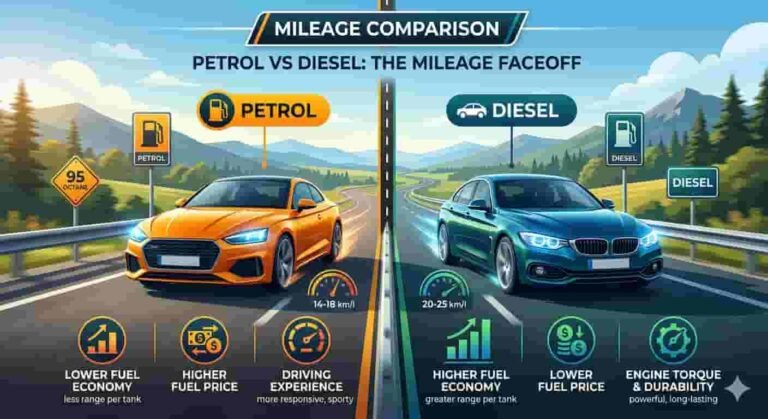
Diesel engines are inherently more fuel-efficient because diesel is more energy-dense than petrol. This is one of the biggest factors in the petrol vs diesel car comparison. Here’s how popular segments compare in real-world Indian conditions:
|
Car Segment |
Petrol Mileage (km/l) |
Diesel Mileage (km/l) |
Diesel Advantage |
|
Hatchback (Swift, Baleno) |
20–22 |
24–28 |
~25% better |
|
Compact SUV (Nexon, Brezza) |
17–19 |
22–25 |
~30% better |
|
Mid-size SUV (Creta, Seltos) |
15–18 |
20–22 |
~25% better |
|
Sedan (City, Verna) |
16–18 |
22–24 |
~35% better |
However, mileage alone doesn’t decide savings. You also need to account for the higher purchase price and maintenance costs of diesel cars. That brings us to the most important calculation of all.
5. Break-Even Calculator: When Does Diesel Start Saving You Money?
This is the question every smart car buyer in India should ask. Diesel costs more upfront — so how long before the fuel savings cover that extra cost?
Break-Even Formula
Break-Even (months) = Extra Cost of Diesel ÷ Monthly Fuel Savings
Monthly Fuel Savings = (Monthly km ÷ Petrol mileage × Petrol price) − (Monthly km ÷ Diesel mileage × Diesel price)
Example 1: Hyundai Creta in Delhi (1,000 km/month)
|
Item |
Petrol Creta |
Diesel Creta |
|
On-road price (approx.) |
₹13.5 lakh |
₹16.5 lakh |
|
Price difference |
₹3 lakh |
|
|
Monthly fuel cost (1,000 km) |
₹5,265 (at 18 km/l) |
₹3,985 (at 22 km/l) |
|
Monthly saving with diesel |
₹1,280 |
|
|
Break-even period |
~234 months (19.5 years!) |
|
Example 2: Hyundai Creta in Delhi (2,500 km/month — highway user)
|
Item |
Petrol Creta |
Diesel Creta |
|
Monthly fuel cost (2,500 km) |
₹13,160 |
₹9,960 |
|
Monthly saving with diesel |
₹3,200 |
|
|
Break-even period |
~94 months (7.8 years) |
|
Rule of thumb: Diesel becomes financially worth it only when you drive 1,500+ km/month consistently and plan to keep the car for 7+ years. Below that, petrol is almost always the smarter financial choice in 2026.
6. Purchase Price Difference: Petrol vs Diesel Car
Diesel cars are more expensive because their engines require stronger components — heavier crankcases, turbochargers, intercoolers, and diesel particulate filters (DPF) mandated under BS6 norms. This is an important factor in any petrol vs diesel car comparison, especially for buyers comparing long-term ownership costs. Here’s what the premium looks like across popular models:
|
Car Model |
Petrol Starting Price |
Diesel Starting Price |
Premium |
|
Hyundai Creta |
₹11.00 lakh |
₹13.90 lakh |
₹2.90 lakh |
|
Tata Nexon |
₹8.10 lakh |
₹10.40 lakh |
₹2.30 lakh |
|
Maruti Suzuki Brezza |
₹8.30 lakh |
₹10.00 lakh |
₹1.70 lakh |
|
Maruti Suzuki Swift |
₹6.50 lakh |
₹7.90 lakh |
₹1.40 lakh |
|
Kia Seltos |
₹10.90 lakh |
₹13.50 lakh |
₹2.60 lakh |
This upfront premium is the core reason why diesel cars need to be driven heavily to make financial sense. The more you drive, the faster you recover this extra cost through fuel savings.
7. Maintenance & Service Costs: Petrol vs Diesel
Maintenance is an often-underestimated cost. Diesel engines are mechanically more complex — and that complexity shows up in your service bills.
Petrol — Maintenance Pros
Simpler engine design. Lower service costs. Cheaper spare parts. No DPF or turbo complications. Compatible with CNG kits.
Diesel — Maintenance Cons
Turbocharger servicing. Diesel Particulate Filter (DPF) cleaning every 50,000–80,000 km. Injector replacements are expensive. 20–30% higher annual service bill.
Estimated Annual Service Cost (mid-size SUV)
|
Service Item |
Petrol (₹) |
Diesel (₹) |
|
Regular service (engine oil, filters) |
4,000–6,000 |
6,000–9,000 |
|
Turbo service (diesel only) |
— |
2,000–5,000 |
|
DPF cleaning (diesel only) |
— |
3,000–8,000 |
|
Fuel injector (if needed) |
2,000–4,000 |
8,000–20,000 |
|
Estimated annual total |
₹8,000–15,000 |
₹14,000–25,000 |
Tip: City driving is especially hard on diesel engines. Frequent idling, stop-go traffic, and short trips prevent the DPF from regenerating properly, leading to costly clogs over time.
8. Performance & Driving Experience
Petrol — smooth, responsive and quiet.
The power delivery is smooth and consistent through the RPMs, and petrol cars can accelerate quickly. They produce less noise while idling and accelerating, which makes them ideal for city driving. NVH (Noise, Vibration, Harshness) performance has improved significantly in modern petrol cars, especially in hatchback and compact sedan segments. For buyers asking petrol vs diesel car which is powerful, petrol vehicles offer smoother acceleration and a refined driving experience that many families and first-time car buyers prefer.
Diesel — Torque-Rich, Highway Friendly
High torque and low revolutions per minute (RPM) means that diesel engines accelerate easily on highways or climbing ghats with a full load. When driving on highways or taking passengers/luggage to work regularly the diesel’s torque really makes a difference. Modern BS6 compliant diesel vehicles from Hyundai, Kia and Tata are much quieter, but the tell-tale diesel grumble is still audible at start-up if you have a keen ear for its sound.
City vs Highway Performance Verdict
|
Driving Condition |
Petrol |
Diesel |
Winner |
|
City stop-go traffic |
Smooth, responsive |
Turbo lag at low speeds |
✅ Petrol |
|
Highway cruising |
Adequate |
Strong torque, effortless |
✅ Diesel |
|
Overtaking/hill driving |
Needs higher revs |
Torque-rich, easy |
✅ Diesel |
|
Cabin quietness |
Very quiet |
Some clatter/vibration |
✅ Petrol |
|
Short trips (under 5 km) |
No issues |
Bad for DPF health |
✅ Petrol |
9. Resale Value: Petrol vs Diesel in 2026
Historically, diesel cars held their resale value better than petrol — because they were seen as more economical and durable. That equation is rapidly changing in 2026.
- Diesel bans: Delhi already restricts diesel vehicles over 10 years. More cities are expected to follow, reducing the buyer pool for used diesel cars.
- Fuel savings gap narrowing: Petrol engines have become much more efficient. Buyers are less willing to pay a premium for used diesel.
- EV and CNG alternatives: Many buyers who would have chosen diesel are now choosing CNG or waiting for EVs, reducing demand for used diesel cars.
- Commercial segment exception: Diesel still holds strong resale value in commercial vehicles, large SUVs, and for buyers in semi-urban and rural markets where mileage is high.
⚠️ Urban buyers beware: If you’re buying in Delhi, Bengaluru, or Mumbai, diesel resale value has dropped noticeably. A 5-year-old diesel car now fetches only marginally more than its petrol equivalent in these cities — erasing one of diesel’s traditional advantages
10. Popular Cars: Petrol vs Diesel Variant Comparison
Hyundai Creta — Petrol vs Diesel
|
Petrol (1.5L NA) |
Diesel (1.5L) |
|
|
Starting price |
₹11.00 lakh |
₹13.90 lakh |
|
Mileage (ARAI) |
17.4 km/l |
21.89 km/l |
|
Power |
115 bhp |
116 bhp |
|
Torque |
144 Nm |
250 Nm |
|
Best for |
City + Weekend trips |
Regular highway users |
Tata Nexon — Petrol vs Diesel
|
Petrol (1.2T) |
Diesel (1.5L) |
|
|
Starting price |
₹8.10 lakh |
₹10.40 lakh |
|
Mileage (ARAI) |
17.01 km/l |
19.01 km/l |
|
Power |
120 bhp |
115 bhp |
|
Torque |
170 Nm |
260 Nm |
|
Best for |
Urban + Tech features focus |
Mixed use, outstation trips |
Maruti Suzuki Brezza — Petrol vs Diesel
Historically, diesel cars held their resale value better than petrol because they were seen as more economical and durable. However, that equation is rapidly changing in 2026, as many buyers now compare petrol or diesel car which is more reliable for long-term ownership, maintenance, and future resale value.
11. Who Should Buy What? Your Personal Decision Guide
Choose Petrol If You…
- Drive under 1,000–1,200 km/month
- Mostly drive in the city
- Plan to sell the car within 5 years
- Have a limited upfront budget
- Live in Delhi, Bengaluru, or any metro with diesel restrictions
- Want lower maintenance hassle
- Prefer a quieter, smoother ride
- Are a first-time car buyer
- Want to convert to CNG later
Choose Diesel If You…
- Drive 1,500+ km/month consistently
- Frequently travel on highways
- Plan to keep the car 7–10 years
- Tow loads or drive in hilly terrain
- Live in a semi-urban or rural area
- Run a business requiring heavy usage
- Drive a large SUV (over ₹20 lakh segment)
- Fuel price gap in your city is ₹12+ per litre
12. The Future of Diesel Cars in India: Should You Be Worried?
This is the question that 2026 buyers are most anxious about — and rightly so. Here’s an honest assessment:
The Diesel Risks
- Diesel bans in metro cities: Delhi already bans diesel vehicles over 10 years old. Discussions about banning new diesel registrations in Delhi and Bengaluru are ongoing and could materialise by 2026–2027.
- BS7 norms on the horizon: Future emission standards will make diesel engines even more expensive to manufacture and maintain.
- EV infrastructure growing: The EV market share in India is rising by 15%+ year-on-year. As charging infrastructure improves, diesel’s “long-range advantage” weakens further.
- Insurance and registration: Some states are increasing road tax and insurance for diesel vehicles as a pollution deterrent.
Diesel Is Not Dead — Yet
- Diesel will remain dominant in commercial vehicles, trucks, buses, and large SUVs for the next 5–8 years.
- In semi-urban and rural India, where EV charging is unavailable and highway driving is the norm, diesel still makes strong practical and financial sense.
- Premium SUVs (over ₹25–30 lakh) continue to offer diesel as a primary option because buyers in that segment drive long distances and prioritise torque and fuel economy.
Our 2026 view: If you’re buying a car you plan to use for 5 years in a metro city, avoid diesel. If you’re buying for 10+ years of heavy highway use in tier-2 or tier-3 cities, diesel still makes sense — but evaluate the specific restrictions in your state before buying.
Conclusion: Petrol vs Diesel Car — The Final Verdict
The petrol vs diesel debate in India has no single winner — it depends entirely on your driving habits, budget, and city.
|
Your Situation |
Best Choice |
|
City commuter, under 1,200 km/month |
Petrol ✅ |
|
Highway user, 1,500+ km/month |
Diesel ✅ |
|
Metro city resident (Delhi, Bengaluru) |
Petrol ✅ |
|
Rural/semi-urban, high daily running |
Diesel ✅ |
|
Short-term ownership (under 5 years) |
Petrol ✅ |
|
Long-term ownership (8–10 years, high use) |
Diesel ✅ |
|
Budget buyer wanting lower upfront cost |
Petrol ✅ |
|
Premium SUV buyer, outstation travel |
Diesel ✅ |
The smartest move? Calculate your exact monthly running, plug it into the break-even formula in Section 5, and let the numbers decide. Don’t buy diesel because “diesel is economical” — that’s outdated advice. Run the actual math for your situation and understand the real petrol vs diesel car comparison before making a decision.
And if you’re still confused about petrol or diesel car which is best for you, remember: petrol is generally the safer, simpler, and lower-risk choice in 2026 — especially as EVs and CNG continue to grow as practical alternatives.
FAQS - Petrol vs Diesel Car
What are the disadvantages of diesel cars?
Diesel cars usually have higher purchase and maintenance costs. They can also face restrictions in some cities due to pollution regulations.
What will happen to diesel cars after 10 years?
In some Indian cities like Delhi, diesel cars older than 10 years may face registration or usage restrictions due to emission rules.
How much diesel is required for 1 hour AC in a car?
A diesel car AC generally consumes around 0.5 to 1 litre of fuel per hour, depending on engine size and AC usage.
Which engine is best for a car, petrol or diesel?
Petrol is better for city driving and low maintenance, while diesel is better for long-distance driving and higher mileage usage.
What is the lifetime of a diesel car?
A well-maintained diesel car can easily last 3 to 5 lakh kilometres with proper servicing and regular maintenance.
Should I buy a diesel car or a petrol car?
Choose petrol for city use and lower running. Choose diesel if you drive long distances regularly and need better fuel efficiency.
Which car has better resale value — petrol or diesel?
The diesel advantage in resale has significantly narrowed. In metro cities like Delhi, Bengaluru, and Mumbai, petrol cars often match or beat diesel cars in resale due to diesel restrictions. In smaller towns and for heavy-use vehicles, diesel still holds slightly better resale value.
Which is cheaper to maintain — petrol vs diesel car?
Petrol cars are cheaper to maintain. Diesel engines require additional servicing of turbochargers, DPFs, and injectors, making annual service costs 20–30% higher than equivalent petrol cars.
Which is more environmentally-friendly — petrol or diesel?
Petrol cars produce less particulate matter and NOx emissions, which directly affect air quality. Diesel cars emit more particulates even under BS6 norms. For urban air quality, petrol is clearly the greener choice. Both, however, produce CO₂, unlike EVs.
Should I buy petrol, diesel, or wait for an EV?
If you need a car now: buy petrol for city use or diesel for heavy highway use. If you can wait 2–3 years, EV options in India will expand significantly with better charging infrastructure and lower prices. CNG is also a strong option if your city has a good CNG network and you drive heavily within the city.